Currency:

2026 / 01 / 26
A strong grip doesn’t come overnight—and it can’t be replaced by shortcuts or “artificial aids” that only mimic real traction. Products like chalk, grip solutions, or rosin-based formulas won’t build your true grip strength. At best, they temporarily “fake” it, giving the illusion that you’re holding better than your current hand strength actually allows. You can use these products as training support, but if your goal is to genuinely strengthen your grip, none of them will do the work for you. That’s why it’s so important not to start with the strongest, ultra-sticky products, which slow down your hands’ natural adaptation to the pole. In this article, I explain why starting with strong grip products and rosin is a mistake—and how to choose the right product so you don’t block your own progress or build your technique on shortcuts from the very beginning.
Table of Contents
- Why do you slip on the pole? Real causes and common myths
- Weak grip is not the same as sweaty hands
- Types of grip products for pole dance and how they differ
- Pole surface and training conditions matter more than you think
- Skin condition and care as part of grip performance
- The best grip product is the one tailored to you
Why do you slip on the pole? Real causes and common myths
Many beginners quickly assume that if they’re slipping on the pole, it must be due to sweaty hands—and that they need the “strongest grip product available.” In reality, this is often not true. In most cases, it has nothing to do with excessive sweating, but rather with the natural process of your skin and grip adapting to a completely new surface—the metal pole. Let’s be clear: there is no single perfect grip product for everyone. The right product depends on your skin type, your training stage, and the conditions you train in.
When you first grab a pole, your hands are experiencing something completely new. For your body, this is a stress response: your hands need to hold on, while touching an unfamiliar surface. As a result, your body activates a natural defense mechanism—sweating. This is not a problem or a disorder; it’s a normal adaptive response. That’s why if someone still has sweaty hands after a month of training, it’s absolutely not a sign of excessive sweating. Your hands simply need time to recognize that contact with the pole is safe and stop overreacting.
Only after two or three years of regular training—when your grip is strong and your technique solid—should persistent excessive sweating be considered a potential issue worth addressing (for example with dermatological consultation or specialized treatments). At the beginner stage, it’s simply part of the adaptation process.
Weak grip is not the same as sweaty hands
Another major factor behind slipping is simply weak grip strength. At the beginning, everyone has a weak grip because the muscles in the hands and forearms are still learning to work in a new way. Combine that with stress-related sweating, and it’s completely normal to slide down the pole.
The problem starts when, instead of allowing your hands to naturally strengthen, you immediately rely on strong adhesive-like grip products. In that case, your hands no longer need to grip tightly—they just stick. You might feel like “finally it works,” but in reality your grip muscles aren’t being properly trained. When you later stop using the product, everything suddenly becomes difficult again. This shortcut ultimately slows down your progress.
Types of grip products for pole dance and how they differ
To choose the right grip product, you need to understand that there are several distinct categories—each designed for different needs, skin types, and training stages.
Chalk for pole dance – why it’s not the best starting point
Classic chalk (magnesium carbonate mixed with alcohol) was originally adopted from climbing. Years ago, it was widely used simply because there were no alternatives. Chalk dries the skin very aggressively and leaves a white residue that absorbs sweat.
The problem? Overly dry skin doesn’t grip better. It becomes smooth, thin, and prone to micro-cracks, which actually worsens grip over time. If you avoid moisturizing and use chalk frequently, your hands can quickly become too dry to grip effectively.
People with naturally dry skin or dermatological conditions should especially avoid starting with chalk, as it can worsen both comfort and performance.
Silica-based grip products – the best choice for beginners
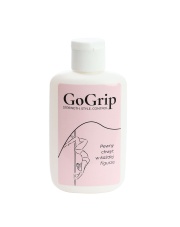
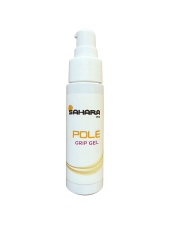
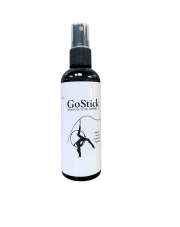
Silica-based grips are a much better option for beginners. They absorb moisture more gently without over-drying the skin, and they don’t leave heavy residue. This allows for a more natural contact between your skin and the pole.
Most importantly, your grip still has to work. Your forearms strengthen naturally while sweat is controlled—without “cheating” the process. Your hands adapt, your skin adjusts, and your grip improves over time.
Some advanced formulas use modified silica that creates a hydrophobic layer. Sweat forms droplets instead of soaking in, which can be wiped away while the product remains effective. This is especially useful during longer or more intense sessions.
However, if someone has extremely sweaty hands, chalk may initially handle moisture better—but it remains more aggressive and requires proper skin care.
Rosin-based products – when they actually make sense
The third category includes rosin-based products, which create a strong sticky effect. These provide immediate grip, even with weak hands.
But starting with them is a mistake. You quickly become dependent on the stickiness instead of building real strength. Once you stop using them, everything feels much harder. Additionally, rosin is banned in many pole competitions.
These products should be treated as advanced tools—for specific situations, difficult tricks, or fatigue—not as a beginner’s solution.
Pole surface and training conditions matter more than you think
Grip is influenced not only by your hands and products, but also by the pole itself. Chrome poles (especially removable ones) tend to be more slippery than powder-coated or stainless steel poles. That’s why many people feel confident in the studio but struggle at home.
Temperature also matters. Studio poles are often warmed up and rooms are heated. At home, poles are colder, warm-ups are shorter, and conditions are different. This alone can significantly affect grip.
Skin condition and care as part of grip performance
Skin condition plays a crucial role. Very dry skin can be just as slippery as sweaty skin. Proper care is essential. During training, aloe gel can provide light hydration without leaving residue. After training, use moisturizing products to restore the skin barrier.
Healthy, elastic skin provides much better grip than dry, irritated skin. Skincare is part of training—not an afterthought.
The best grip product is the one tailored to you
There is no universal “best grip product.” Grip depends on your training level, strength, skin condition, sweating, pole type, and environment. Instead of chasing the strongest product, start with lighter solutions and allow your grip to develop naturally.
For most beginners, silica-based grips are the best option—they support grip without blocking progress. Chalk can help with heavy sweating but requires proper care. Rosin products should be used strategically, not as a foundation.
If you’re still struggling, look beyond products—consider your pole, environment, warm-up, and skin condition. Only by looking at the full picture will you find the real solution to slipping.