Currency:

2026 / 07 / 06
Which exercise hammock should you choose? Aerial Yoga, Pilates, Fitness and acrobatics
Choosing an exercise hammock is not just about colour or price. The most important factors are its intended use, fabric length, suspension height, width and stretch. These parameters determine whether the hammock will work well for yoga, Pilates, fitness, aerial acrobatics or simply as a home swing for a child.
The most common question is: are there separate hammocks for Aerial Yoga, Aerial Pilates, Aerial Fitness and acrobatics? In practice, the differences do not always come down to the fabric itself, but mainly to the way it is suspended and how much working length is needed. That is why, before buying, it is worth deciding who will use the hammock, what exercises will be performed and where it will be installed.
Where to start when choosing an exercise hammock
First, answer three basic questions. Firstly, what type of training the hammock will be used for. Secondly, whether it will be used at home or in a training studio. Thirdly, what the ceiling height is. These three pieces of information immediately help narrow down the options.
Many people assume that one model will be perfect for everything. That is not always the case. Yes, the same type of fabric can be used across several disciplines, but it will perform differently in calmer adult classes than in acrobatics, where greater length and more freedom of movement are needed.
Types of exercise hammocks by use
Hammock for Aerial Yoga and Aerial Pilates
A yoga and Pilates hammock is most often chosen by adults. In these forms of movement, the fabric is used to unload the body, provide support, assist stretching, encourage relaxation and perform controlled positions. Usually, there is no need to buy a very long hammock, as these activities do not require as much working fabric as acrobatics.
For home use, a standard length of 5 metres is usually sufficient. If the ceiling is higher, you do not necessarily need to choose a longer fabric straight away. In many cases, a daisy chain is enough — a looped height-adjustment system that lowers the working point of the hammock without changing the knots.
Hammock for Aerial Fitness
Aerial Fitness differs from yoga and Pilates in the nature of the exercises. It includes more strength-based and repetitive movements, such as squats, planks, leg raises and stabilisation exercises. For this reason, the hammock should be set slightly higher than in typical relaxation or yoga use.
For fitness training, it is important for the fabric to sit roughly at stomach height. This setup makes strength exercises easier to perform and gives better control over movement. The fabric itself may be similar to the one used for yoga, but the key factor is the setup and height adjustment for the specific exercise type.
Hammock for aerial acrobatics
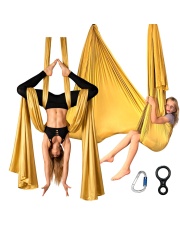
This is a completely different category of use. In aerial acrobatics, the fabric is used not only to support the body, but also for wraps, entering figures and building movement sequences. That is why hammock length becomes especially important here.
Professional acrobatic hammocks are usually 6 to 10 metres long. This range gives more technical possibilities and allows you to use a larger section of the fabric. At home, however, making full use of a very long hammock can be difficult, as standard room height is usually around 2.5 to 3 metres.
If the hammock is intended for home acrobatic practice, 6 metres is often a sensible compromise. In this case, it is important for the fabric to start as high as possible, practically from the ceiling attachment point itself. The goal is to preserve as much working length below as possible.
Children’s hammock vs acrobatic hammock for children
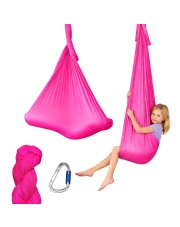
This distinction is very important. When someone looks for a hammock for a child, they may mean two completely different things. The first is fabric for resting, swinging and free play. The second is equipment for acrobatic training.
If the child simply wants to lie down or swing, there is no need to choose a typical sports configuration straight away. However, if the child trains acrobatics and will be performing figures with wraps around the fabric, the hammock must be set up to provide the right working length and suitable conditions for learning technique.
Do Aerial Yoga, Aerial Pilates and Aerial Fitness require different hammocks?
In practice, not always. Many people are surprised to learn that the difference often lies not in the fabric itself, but in the suspension setup. Yoga and Pilates usually use similar parameters, while fitness requires a different height setting due to the type of exercises performed.
This means that, in many cases, you can work with the same type of hammock, provided it is installed correctly and allows height adjustment. That is why a daisy chain is such a useful accessory, as it allows you to change the suspension level quickly without retying knots every time.
What hammock length should you choose?
Length is one of the most important parameters when buying a hammock. Fabric that is too short will limit your options, while fabric that is too long in a low room may simply be inconvenient.
5 metres
This is usually a safe choice for home use, especially for Aerial Yoga, Aerial Pilates and many recreational purposes. With a standard ceiling height, this length usually provides enough functionality. If slight lowering is needed, adjustment loops can be used.
6 metres
This is a good option for those who want more fabric to work with, especially for exercises closer to acrobatics. At home, 6 metres can be a reasonable choice when greater versatility is needed, although room height limitations still have to be considered.
7 metres and more
This range makes more sense in spaces with more than 3 metres of height or when the equipment is intended for more professional use. In a low apartment, a very long hammock can be harder to set up and may not offer a real advantage if the space does not allow you to use its full potential.
Professional range: 6 to 10 metres
This range applies mainly to hammocks used in aerial acrobatics. The longer the fabric, the more options you have for figures and wraps. This is especially important for people training technically rather than purely recreationally.
How high should you hang the hammock?
There is no single universal height for every use. The setup depends on the type of training.
In yoga and Pilates, the hammock is often positioned lower so that you can comfortably enter it, support the body and use the fabric during decompressive positions. In fitness, the working point should be higher, usually around stomach height, as this makes strength exercises easier. In acrobatics, the priority is for the fabric to start as high as possible, increasing the available working length.
At home, ceiling height has a major impact on what is possible. Before buying, it is worth measuring the distance from floor to ceiling and considering whether your planned exercises require more fabric below the attachment point.
How many suspension points do you need?
For the use described here, one suspension point is enough. This is important for anyone planning home installation, as it makes preparing the space and choosing accessories simpler. When buying, however, make sure that the entire mounting system is suitable for the loads generated during exercise.
What hammock width is suitable?
The standard width is considered to be 280 cm. This is not accidental. This width allows you to get inside the hammock, lie down in the fabric and perform exercises that require a larger support surface.
Narrower fabrics are also available, for example 160 cm wide, but they are associated more with aerial silks than hammocks. In practice, this width does not offer the same comfort. For most adults, it is simply too narrow to use comfortably in the way a hammock is normally used.
If your goal is hammock-based exercise, resting in the fabric or positions where the body is partly or fully wrapped in the material, 280 cm is far more functional.
Fabric stretch: low stretch or medium stretch?
This parameter is often overlooked, but it has a major impact on comfort and training possibilities. In practice, you will usually find fabrics with low or medium stretch.
Low stretch means lower elasticity, around 7 percent. Medium stretch means medium elasticity, around 10 percent. In acrobatics, federations and rulebooks often indicate medium stretch for hammocks between 6 and 10 metres long.
At home, the situation is slightly different. If the room is low, fabric with too much stretch may limit your practice because the hammock elongates more under load, leaving less space for movement. That is why lower stretch is often the better choice for home use, as it gives more control and more usable space.
Home or studio: which hammock works better?
Hammock for home use
At home, you usually need to compromise between hammock length and room height. In a standard apartment or house, lengths of 5 or 6 metres usually work best. These parameters make it easier to adapt the equipment to everyday practice and avoid excess fabric.
If the home hammock will mainly be used for yoga, Pilates, recreation or gentler fitness exercises, 5 metres is often more than enough. If more technical elements are planned and more working fabric is needed, 6 metres can be considered, provided the space allows it.
Hammock for a studio or training room
Higher spaces offer more possibilities. They make it easier to use longer hammocks, especially for acrobatics. A studio also gives more freedom to set the suspension height according to a specific training method.
If the space is high, you do not need to limit yourself to basic lengths. In these conditions, longer fabric makes sense and genuinely increases the range of possible uses.
How to adjust hammock height
In practice, there are two main methods. The first is using a daisy chain, a looped strap that allows you to lower the hammock quickly by clipping the carabiner into a different loop. This is a convenient solution for people who want to change the setup depending on the exercise.
The second method is moving the knot on the fabric, if the hammock length allows it. This lets you create more or less working fabric below. This solution can be practical with longer fabrics, but it requires proper setup and an understanding of how the change will affect the hammock position.
Common mistakes when choosing a hammock
Buying without defining the purpose
This is the most common issue. A hammock chosen “for everything” may not be optimal for anything specific. A person practising yoga needs different parameters than someone doing fitness training or a child learning acrobatics.
Ignoring room height
Even a very good hammock will not be comfortable if its length does not match the installation conditions. At home, with a low ceiling, fabric that is too long and too stretchy can limit movement instead of supporting it.
Confusing a hammock with aerial silks
A 160 cm wide fabric offers completely different functionality than a 280 cm width. If you want to get inside the hammock and perform typical exercises with full-body support, wider fabric is much more suitable.
Overlooking stretch
Stretch affects the feel of the exercises and the amount of available working space. At home, lower stretch is often more practical than a more elastic fabric.
No height adjustment option
If the hammock is intended for different types of activity, it is worth ensuring quick height adjustment. This is especially important when one person wants to use the hammock for relaxation and another for more dynamic exercises.
How to choose a hammock for your needs
The best approach is to go step by step. First, decide whether the hammock will be used for yoga, Pilates, fitness, acrobatics or recreational swinging. Then measure the room height. Next, decide how much adjustment you will need in everyday use.
If the priority is calmer adult classes, a good starting point is a 5-metre hammock with a width of 280 cm. If the goal is more strength-focused training or greater versatility, a fitness-style setup or 6-metre fabric may be worth considering. If acrobatics is the main focus, the priority should be maximum working length and the right suspension method.
Practical recommendations
For most people training at home, the safest and most versatile choice will be a hammock with a length of 5 or 6 metres. With a standard ceiling, this is usually the most functional range. It is also worth paying attention to the 280 cm width, as it provides real comfort in use.
If space is limited, it is better not to overdo the length or stretch. In these conditions, a less stretchy fabric is usually more practical because it is easier to control and preserves more usable height during exercise.
If the hammock is intended for a child practising acrobatics, the fact that it is for a child does not automatically mean the fabric should be shorter. On the contrary, for figures and wraps, a longer hammock provides more technical possibilities. However, this must always be balanced against the actual installation space.
Summary
The most important rule is simple: choose a hammock based on its intended use, not just the name of the discipline. Yoga, Pilates and fitness may use similar fabric, but different setups. Acrobatics usually requires greater length and as much working fabric as possible. For home use, the best choice is usually 5 or 6 metres, a width of 280 cm and well-planned height adjustment.
Before buying, check your ceiling height, define the type of exercise and decide whether versatility, relaxation, strength training or acrobatic technique development matters most. This will make it much easier to choose a hammock that is genuinely comfortable and useful in everyday practice.
FAQ
Do Aerial Yoga and Aerial Pilates require different hammocks?
Usually, no. In many cases, similar fabric can be used, and the main difference lies in the setup and suspension height.
What is the best hammock length for home use?
5 or 6 metres usually works best. This is the standard choice for most home uses with typical ceiling height.
Is 7 metres a good choice for an apartment?
It can be, but it usually only makes sense when the room has more than 3 metres of height. Otherwise, the fabric may be too long for comfortable everyday use.
How many attachment points are needed for a hammock?
For the use described here, one suspension point is enough.
Why is 280 cm width so popular?
Because it allows you to comfortably enter the hammock, lie inside it and perform exercises that require a larger fabric surface. Narrower fabrics are better suited to aerial silks.
What stretch is better for home use?
In low rooms, lower stretch often works better because it provides more control and helps preserve more working space.
Is an acrobatic hammock for a child different from a regular recreational hammock?
Yes, because acrobatics requires enough fabric for figures and wraps, which means a different approach to length and suspension setup.