Currency:

2026 / 07 / 06
Aerial silks: how to choose fabric, stretch and thickness for your skill level and training style
Choosing the right aerial silks has a real impact on comfort, safety and progress. The differences between materials are not just about colour or brand. The type of knit, finish, stretch, thickness, silk length and intended use all matter. One silk may work best at the beginning, another for strength work, and another for drops and more advanced dynamic training.
The most important rule is simple: there is no single perfect aerial silk for everyone. Some silks are better or worse suited to a specific person, their strength, pain sensitivity, technique and training goals. That is why two people can have completely different experiences on the same fabric.
What exactly are aerial silks?
Aerial silks are not a random piece of fabric. They are a technical textile whose properties are shaped by the production process. On the Polish market, aerial silks are most commonly made from knitted fabrics. Their structure differs from woven fabrics and warp-knitted fabrics, which are often used in other applications where greater material stability is required.
In practice, this means that two silks may look similar but behave completely differently during climbs, footlocks, drops or dynamic work. How the fabric performs in the air depends not only on the raw material itself, but also on the knit and final finish.
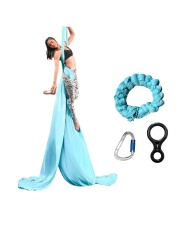
If you are just putting your equipment together, it is worth starting with a solid understanding of the basics. General information about aerial silks and their training and stage applications can be helpful.
What are aerial silks made of?
The most commonly used material is polyester. There is a reason it has become the standard in this field. It is stable, durable and resistant to the typical loads involved in aerial silk use. Compared with less technical solutions, it allows the final properties of the fabric to be controlled more effectively.
However, this does not mean that all polyester silks are the same. Differences may come from many stages of production. The yarn, knitting method, type of knit and, above all, the final stabilisation of the material all matter. Even if the base is very similar, the finished result can be different.
Knit, construction and finish
In practice, how the material is made is extremely important. Different knit structures are available, and each one affects grip, fabric behaviour and the way the silk feels during training. The fact that a material is polyester does not yet tell you whether it will be soft, rough, thin, substantial, springy or firm.
The final stage of production, stabilisation, is also key. This is when the amount of give left in the fabric structure is largely determined, along with how much the silk will stretch. Two materials made from similar yarn and a similar knit can have completely different performance properties after this stage.
Why drops load aerial silks differently than regular training
Stretch does not come only from the type of fibre. A lot depends on how strongly the material has been stabilised during finishing. The more it has been “stretched out” and set at the end of the process, the firmer and less stretchy it usually becomes.
This matters because, in aerial training, the percentage of stretch directly affects how the fabric feels at height. A small difference in parameters can make a big difference in practice. With short silks, stretch will be less noticeable. With long silks, the same percentage can turn into dozens of centimetres of additional fabric movement.
Why silk length changes everything
This is one of the most commonly overlooked topics. Fabric stretch is percentage-based, so the longer the silk, the more noticeable its movement becomes. A short home silk may feel fairly stable, while the same material hung high in a studio can suddenly behave completely differently.
This matters for climbs, strength work, footlocks and drops. A fabric that feels comfortable on a low rig may require much more strength at greater height and respond at a different pace. That is why, when assessing aerial silks, you should always consider not only the type of fabric, but also the working length.
Thinner and firmer, or thicker and more stretchy?
This is one of the most important questions when choosing aerial silks. The answer depends on your level and training style.
When a thinner and less stretchy silk works better
This type of fabric is often a good choice for beginners, especially children and many women who need an easier grip closure. A thinner silk allows the hand to close more fully, which helps use forearm strength more effectively and gives greater control. The fuller the grip, the easier it is to generate the strength and friction needed to climb.
Lower stretch is another advantage. When climbing, you do not have to work against as much fabric resistance. For a beginner, this is a major relief. First climbs become more achievable, and training feels less frustrating.
This is why firmer and thinner silks are often seen as more beginner-friendly. However, that does not mean they are the best choice for every application.
When a thicker and more stretchy silk works better
As skills improve, needs change. An advanced aerialist usually has more strength, so easy grip closure is no longer the most important factor. What starts to matter is how the fabric behaves during more complex sequences, drops and longer work in the air.
A more elastic and thicker silk can disperse energy better during drops. It provides a smoother deceleration, which can make drops feel less aggressive for both the body and the material. For many people, this is a significant advantage when training techniques based on flight and catch.
On the other hand, not every advanced aerialist will prefer a softer fabric. In dynamic work, some aerialists prefer a firmer, more predictable material that gives less energy back. This shows that aerial silks should be chosen for a specific purpose, not simply according to a beginner-versus-advanced divide.
How to choose aerial silks for your training style
The most practical approach is to match the fabric to what you actually want to train. One silk may support progress in one area and hold you back in another.
For learning the basics and climbs
At the beginning, the best choice is usually a material that supports grip and does not “run away” too much under load. This makes first climbs, hangs and basic wraps more accessible. It is especially important for people starting without previous gymnastics preparation.
For strength work
If the goal is building strength and climb technique, the best choice may be different than for choreography or dynamic work. Lower stretch often makes the task easier, but it also partially reduces the demands the fabric places on the body. That is why, in strength training, it can sometimes make sense to use different types of silks depending on the goal of the session.
For drops and falls
For drops, the material’s ability to disperse energy becomes important. A more elastic silk can provide a smoother catch after the flight. This affects comfort, wear rate and how the drop itself feels.
For dynamic work and releases
In dynamic training, some people prefer firmer and more predictable silks. This type of material does not rebound the body as strongly and allows better control over the moment of generating momentum. It is not an absolute rule, but it is a common preference in more technical work.
In practice, the most aware aerialists often use more than one type of fabric. This is not a whim, but a logical way to match the tool to the task.
Why drops load aerial silks differently than regular training
During a drop, the body transfers energy into the fabric in a very short time. The faster the silk stops the movement, the stronger the braking force feels. It is similar to sudden braking in a car. A shorter stopping distance means greater force felt at that moment.
A firmer and thinner silk stops more abruptly. This may mean stronger pain sensations and greater load on the areas where the fabric works under the highest friction. A more elastic silk dissipates energy more slowly, so the flight may feel gentler for the body.
Heat and friction during drops
Intensive drops generate heat. This is a normal result of friction and fabric movement under load. The upper rigging point is especially exposed, particularly if the silk works on a figure eight or similar piece of hardware. This is where large forces accumulate, and the fabric has nowhere left to “give” through its elasticity.
If you perform a lot of drops, it is worth regularly checking not only the top of the silk, but also the areas most often involved in specific sequences. In some tricks, wear may also appear where the fabric slides intensely across the body or works locally in one point.
Damage to training clothing caused by friction can also be a useful warning sign. If costume fabric or leggings become scorched or visibly worn through, the silk should also be inspected very carefully.
The right hardware also matters when choosing and checking equipment. For rigging, it is worth understanding the basic solutions available in the hardware for hammocks and aerial silks category, including components used for safe installation and fabric movement.
Can the colour of aerial silks affect their properties?
Yes, it can. However, it is not about the colour itself, but about how the material was stabilised after dyeing. Darker shades usually require higher temperatures during setting. This can affect the final stiffness of the fabric.
In practice, darker silks may be firmer than lighter ones, but this is not a rule without exceptions. A lot depends on how the manufacturer runs the process and whether all colours are finished according to the same procedure. If the process is well controlled, the differences may be small. If not, the variations can be more noticeable.
This also explains why two batches of seemingly the same fabric may not behave identically. Even if the differences are small, an experienced aerialist may feel them.
Can two batches of the same silk be different?
Yes, although with a well-controlled process, the differences should be small. The origin of the yarn, its storage conditions and the details of final stabilisation can all have an impact. Technical textile production does not always produce an identical result down to every metre of fabric.
Within one production batch, parameters are usually very similar. However, if the next batch is produced several months later, minor differences are possible. This does not necessarily mean a defect. It is more a feature of the process and something worth considering when comparing materials.
Why aerial silks change over time
Even a well-made silk does not stay exactly the same throughout its entire period of use. The material works under load, so it may gradually lose some of its original characteristics. This often appears as slight “stretching out” and a change in how the elasticity feels.
This is a natural effect of use. Some silks will change faster, others more slowly, depending on their construction and how they are used. Intensive drops, frequent training and storage conditions all accelerate wear.
If you want to understand the material parameters better, information about the fabric used for aerial silks and the features that affect safety and comfort can also be useful.
How to assess silk strength and what not to assume automatically
In the industry, laboratory test results carried out according to specific standards are often referenced. They are an important point of reference, but it is important to understand what such tests actually show. Testing a small fabric sample stretched in simple conditions does not fully reflect what happens to a silk that is rigged and used in real training.
In practice, the material at the top is bent, works in a knot or on hardware, is exposed to local friction and experiences uneven force distribution. This is a completely different situation than laboratory stretching of a straight strip of woven or knitted fabric. That is why a single number given as strength does not always say as much as it may seem at first glance.
A sensible question for the manufacturer is not only: “What standard does the material meet?”, but also: how does it behave in real rigging and practical use?
The most common mistakes when choosing aerial silks
Choosing only based on other people’s opinions
What is perfect for one person may be uncomfortable or too difficult for another. Sensitivity to pressure, grip strength, technique and training goals vary a lot.
Ignoring rigging length
The same fabric on a low rig and a high rig can feel completely different. Without considering length, it is hard to judge whether the issue is really the silk or simply the training conditions.
Assuming that a “more advanced” silk is automatically better
There is no point choosing a fabric only because it is considered professional. If it makes learning the basics harder, it may slow progress instead of supporting it.
Not checking wear regularly
The most exposed areas are the upper rigging point and sections that work intensively during specific sequences. An occasional visual check “by eye” is not enough.
Confusing “it does not suit me” with “it is bad”
This is a common misinterpretation. A silk can be very good quality but unsuitable for a particular stage or style of training.
How to safely inspect your aerial silks
Equipment inspection should be a habit, not a one-off action. Before getting on the apparatus, check the material along its entire length, paying particular attention to the top, the areas most often used in drops and points exposed to friction.
Look for concerning abrasions, local stiffening, changes in structure, signs of overheating and anything that differs from the material’s normal appearance. If anything raises doubts, the equipment should be taken out of use until it has been properly assessed.
Figure eights are often used in rigging, so it is also worth understanding their role and limitations. One example is a figure eight for aerial silks, which affects how the fabric works at the attachment point.
How to choose aerial silks for your own needs
The best starting point is answering three questions. First, what is your level and grip strength? Second, what type of training do you do most often? Third, at what height do you usually train?
If you are just starting out, it is usually worth looking for a material that makes gripping and first climbs easier. If you are already training drops, dynamic work and more demanding combinations, the choice should be more precise. At that stage, subtle fabric properties matter, not just whether the silk is easy to climb.
In the long term, it can make sense to own more than one type of silk. One for basics and strength work, another for drops, and a third for a specific type of dynamic training. This is a more professional solution, but also simply practical.
Summary
A good aerial silk is not the one with the best reputation in isolation, but the one that matches your real needs. Your choice should depend on your level, hand size, grip strength, training style, rigging height and individual preferences.
Thinner and firmer fabrics often support the beginning of training. Thicker and more elastic materials may work better for some advanced applications, especially where smoother energy dispersion is important. In dynamic work, a more predictable and firmer material sometimes works better. All of this means one thing: aerial silks should be chosen for the task, not according to one universal rule.
The most informed choice combines an understanding of the material with regular equipment inspection. In aerial training, this is not a detail, but the foundation of safe and effective practice.
FAQ
Should beginner aerial silks always be thin?
Not always, but a thinner silk often helps close the grip and makes first climbs easier. This can be especially helpful for smaller hands or weaker grip strength.
Is a more elastic silk safer for drops?
It can provide smoother deceleration and a less abrupt catch, but safety also depends on technique, rigging method, wear inspection and the overall condition of the equipment.
Does a dark colour mean a stiffer silk?
Not necessarily, but it can. The deciding factor is the stabilisation process after dyeing, not the shade itself.
Why does my silk feel different after some time?
The material works under load and gradually wears with use. This may affect the perceived stretch and the overall way the silk behaves.
Is one silk enough for everything?
At the beginning, often yes. Over time, however, different training styles may require different fabric properties.