Currency:

2026 / 07 / 08
Choosing the right pole dance pole affects not only your training comfort but also safety, equipment durability and grip quality. One of the most common questions when buying a pole is: should you choose a one-piece pole or a sectional model? While both may look similar, they differ in materials, performance during dynamic movements, wear resistance and intended use.
Whether you're training at home, just starting out, or trying to understand the price difference between entry-level and premium models, this guide will help you make an informed decision. This is especially important when comparing budget-friendly poles with the premium equipment used in professional studios and pole schools.
What is the difference between a one-piece and a sectional pole?
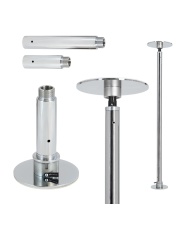
The biggest difference lies in the construction and materials. A one-piece pole is made from a single continuous section, while a sectional pole consists of multiple connected segments. Although this may seem like a small difference, it has a noticeable impact on grip, rigidity and long-term durability.
Premium one-piece poles are typically made from polished stainless steel. More affordable sectional models are often manufactured from chrome-plated steel. Beginners may not notice the difference immediately, but with regular training it becomes much more apparent.
It's also worth noting that a sectional pole doesn't need to be completely disassembled after every session. Most users simply remove the assembled pole and lean it against a wall. Separating the individual extensions is usually only necessary for transport or moving house.
Sectional poles were primarily developed as a more affordable and transport-friendly solution. Their shorter components reduce shipping costs and make them much easier to transport in a standard passenger car.
Grip and pole finish materials
For many people, the most important question is: which pole offers better grip? The surface finish plays a huge role here. Polished stainless steel feels very different from chrome-plated steel.
Chrome can be noticeably more slippery, making it easier to lose grip on a sectional pole, especially if you've previously trained on premium equipment. Stainless steel generally provides more consistent grip and warms up to body temperature faster, creating more predictable training conditions for many users.
This becomes particularly important if you train regularly in a studio and want to buy a similar pole for home use. If your studio uses premium one-piece poles but your home setup features a chrome-plated sectional model, you'll likely notice the difference almost immediately. Often this isn't caused by poor technique but simply by the characteristics of the material itself.
In photos, both finishes may look almost identical. In reality, the difference becomes obvious during your first few training sessions. Polished stainless steel reaches body temperature more quickly, allowing many users to experience better grip. Chrome-plated surfaces remain cooler for longer and can feel noticeably more slippery, especially in colder rooms.
The easiest way to identify the material is with a magnet. If it sticks to the pole, it is usually chrome-plated steel. If it doesn't react, the pole is most likely made from stainless steel.
Does pole diameter matter too?
Yes. A smaller diameter is often easier to wrap your hand around, making it feel easier to grip. However, diameter alone cannot compensate for a slippery surface. If the finish provides less traction, overall comfort will still be noticeably lower than on a premium one-piece pole.
Why does a one-piece pole cost more?
The higher price isn't simply about branding or appearance. With pole dance poles, cost depends heavily on the materials used and how the equipment performs under intensive use.
A premium one-piece pole may cost significantly more than a sectional model because it:
-
is made from stainless steel rather than less expensive chrome-plated carbon steel,
-
features a more durable construction designed for long-term use,
-
handles intensive training and high lateral forces more effectively,
-
typically provides superior grip and a smoother spinning experience.
In practice, you're paying not only for the product itself, but for how it performs after months and years of regular training.
The manufacturing process also contributes to the price. Most sectional poles are mass-produced as standard catalogue products. Premium one-piece poles are often built to order, undergo additional quality inspections and are individually matched to the ceiling height of the installation.
Every extra inspection for straightness, polishing quality and component fit increases manufacturing costs, but also improves durability and overall user experience.
Durability and resistance to damage
One of the biggest differences between these two designs is longevity. Even if the surface of a stainless steel one-piece pole becomes scratched, the material underneath is still stainless steel, significantly reducing the risk of corrosion.
With sectional poles made from chrome-plated carbon steel, the situation is different. If the chrome coating is deeply damaged and the underlying steel becomes exposed, rust may eventually develop. This applies not only to the pole itself but also to components such as the base or extensions if they are made from the same material.
This doesn't mean every sectional pole will wear out quickly. It simply means that under long-term, intensive use, its durability will generally be lower than that of a stainless steel model.
Pole dance studios choose one-piece poles not only because of their superior grip but also because they can withstand years of heavy daily use. Studio equipment is used for many hours every day, making long-term durability essential.
Stability during dynamic training
A sectional pole is built from connected segments. This makes it easier to transport and more affordable, but it also introduces certain limitations. The connection points are naturally more susceptible to lateral movement. During relaxed training this may not be noticeable, but during powerful climbs, fast spins and dynamic tricks the pole may flex more.
This doesn't mean sectional poles are automatically unsafe. Rather, they generally offer less rigidity and a lower level of comfort than a one-piece design. The greater the forces generated during movement, the more obvious the advantages of a continuous construction become.
For this reason, sectional poles are more commonly chosen for home use by beginners, while one-piece poles are the standard in studios and schools where equipment is used intensively every day.
Every connection point is an additional component working under load. Modern systems are very well engineered, but from a mechanical perspective, a single continuous structure will always be stiffer than a modular one. That's why one-piece poles have become the standard in professional pole dance studios and training facilities.
When is a sectional pole the right choice?
A sectional pole makes the most sense if your priorities are a lower upfront cost and beginner to intermediate home training. It's a practical solution for people who want to start pole dancing without immediately investing in studio-grade equipment.
It is particularly suitable if you:
-
are just starting pole dance,
-
train recreationally,
-
are looking for a more affordable home pole,
-
don't expect very intensive use,
-
want a more budget-friendly option.
If you're considering this type of pole, it's worth exploring the available home pole dance poles to compare different designs and installation methods.
A sectional pole is also a great choice if you move frequently or need equipment that's easier to transport. Its shorter sections make moving and shipping much more convenient.
When is a one-piece pole the better option?
A one-piece model is the better choice if you're looking for equipment that closely matches what you'll find in professional pole dance studios. It's worth considering if you:
-
train regularly and more intensively,
-
practice spins and dynamic combinations,
-
want superior grip,
-
plan to invest in equipment for many years,
-
need a solution for a studio, school or professional environment.
In that case, it's worth comparing the available pole dance poles based on material, diameter and installation system.
It's also the best choice for anyone who wants to recreate studio-like training conditions at home. This way, switching between home and studio training won't require you to adapt to a different surface finish or different pole behaviour during spins.
Can both types be permanently installed?
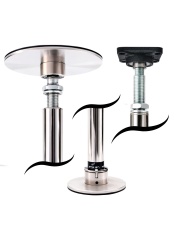
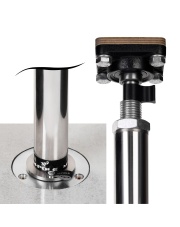
Yes. Both sectional and one-piece poles can be permanently mounted to the ceiling if the design of the specific model allows it. This is particularly useful if your ceiling is uneven or if your installation requires a more customised mounting solution.
A permanent mount can also be beneficial when you need to bypass plasterboard ceilings or create a smaller installation opening than would be required for a larger ceiling dome. In practice, this provides greater flexibility when planning your installation.
It's also worth looking at the available pole dance pole accessories, as the right mounting and maintenance components have a real impact on convenience and long-term performance.
Keep in mind that both sectional and one-piece poles can be installed either using a pressure-fit system or a permanent ceiling mount. The installation method depends on the mounting system you choose and the conditions in your room, not on whether the pole is sectional or one-piece.
The most common mistakes when choosing a pole dance pole
Comparing price alone
The cheapest option isn't always the best value. If the pole turns out to be too slippery, less stable or less durable after a few months, the initial savings may not be worth it.
Ignoring the material
The material has a major impact on grip, training feel and durability. Two poles that look nearly identical can provide completely different training experiences.
Buying a home pole that's completely different from the one used in your studio
People who train on stainless steel poles in a studio are often disappointed when switching to a more affordable chrome-plated pole at home. The difference can affect both confidence and perceived progress.
Choosing the wrong model for your training style
Occasional home practice has different requirements than daily training focused on dynamic tricks. The more frequently and intensely you train, the more important build quality becomes.
How to make the right buying decision
The easiest approach is to answer three simple questions:
-
How often will you train? Occasionally or several times a week?
-
What's your current level? Beginner, intermediate or advanced?
-
Do you want to replicate studio conditions? If so, both the material and construction are crucial.
If your goal is an affordable way to start training at home, a sectional pole may be all you need. However, if you're looking for better durability, superior grip and a more professional training experience, a one-piece pole is usually the better investment.
It's also worth considering whether the pole will be used occasionally or for years of intensive training. In the long run, the price difference often becomes insignificant compared to the added durability and overall comfort.
Summary
A sectional pole is a more affordable option, making it ideal for beginners and lighter home training. A one-piece pole provides better grip, greater durability and a more stable experience during regular and dynamic training.
The biggest difference isn't the appearance—it's the materials used and how the pole performs during training. If you're looking for long-term quality, professional performance or a home setup that closely matches studio conditions, a one-piece model is usually the better investment.
That doesn't mean a sectional pole is a poor choice. For many people, it's the perfect way to begin their pole dance journey. The key is choosing equipment that matches your goals, training frequency and expectations for comfort, allowing it to support your progress for years to come.
FAQ: one-piece vs sectional pole dance poles
1. Which pole dance pole is better for beginners?
A sectional pole is often sufficient for beginners, especially if you're training at home on a limited budget. However, keep in mind that it may be more slippery and less rigid than a one-piece model.
2. Why is a one-piece pole more expensive?
The higher price mainly reflects the use of premium materials—particularly stainless steel—and a construction designed for intensive, long-term use.
3. Is a chrome-plated pole more slippery?
Yes. Chrome often feels more slippery than stainless steel, and many people notice the difference from their very first training session.
4. Is it safe to train on a sectional pole?
Yes, provided it matches your skill level and training style. For highly dynamic and intensive training, however, a one-piece pole is generally the better option.
5. Is a sectional pole suitable for a pole dance studio?
Professional studios usually choose one-piece poles for intensive daily use. Sectional models are better suited to home training or more budget-conscious setups.
6. Which is more durable: stainless steel or chrome-plated steel?
In this application, stainless steel offers superior durability, particularly in terms of damage resistance and protection against corrosion after scratches.
7. Can a scratched pole rust?
If the underlying material is carbon steel, deep scratches can eventually lead to rust. Stainless steel poles are much less susceptible to this problem.
8. Does pole diameter affect grip?
Yes. A smaller diameter is often easier to grip, but it won't compensate for a slippery surface finish.
9. Is the difference between these poles noticeable during spins?
Yes, especially during powerful entries and movements that generate greater lateral forces. Under these conditions, a one-piece construction generally feels more stable.
10. Do the joints in a sectional pole weaken the construction?
Yes. Connection points are naturally more prone to lateral movement than a single continuous tube. This is one of the key structural differences.
11. Can both poles use a similar ceiling dome?
Yes. The upper mounting components may look very similar, but the main differences still come from the materials used.
12. Can a sectional pole be permanently installed?
Yes. A permanent ceiling mount can be used if the specific model and installation conditions allow it.
13. When is it worth paying more for a premium model?
It's worth considering if you train regularly, are at a higher skill level, perform frequent spins, or want equipment that will last for many years.
14. Should my home pole be the same as the one used in my studio?
If you want a similar training experience, yes. Differences in material and construction can affect grip, confidence and how you perceive your progress.
15. Does a cheaper pole mean poor quality?
Not necessarily. It usually reflects different materials and a different intended use. For basic home training, it may be perfectly adequate.
16. What affects comfort more: construction or material?
Both are important. The material largely determines grip, while the construction affects stability and how the pole behaves under load.
17. Are the differences more noticeable during dynamic training?
Yes. The more dynamic the movement, the more obvious the advantages of a stiffer one-piece construction become.
18. Which type of pole should I avoid if I want equipment that lasts for years?
If you plan to train intensively for many years, be cautious with models made from lower-grade materials and modular designs. In that situation, a professional-grade one-piece pole is usually the better investment.